Answers
What We Learned From CAA’s 2026 EV Circuit
CAA’s 2026 EV Circuit put electric vehicles through a 230-km real-world road test, revealing differences in range, efficiency, charging and cost.

Sep 24, 2026
5 min. read
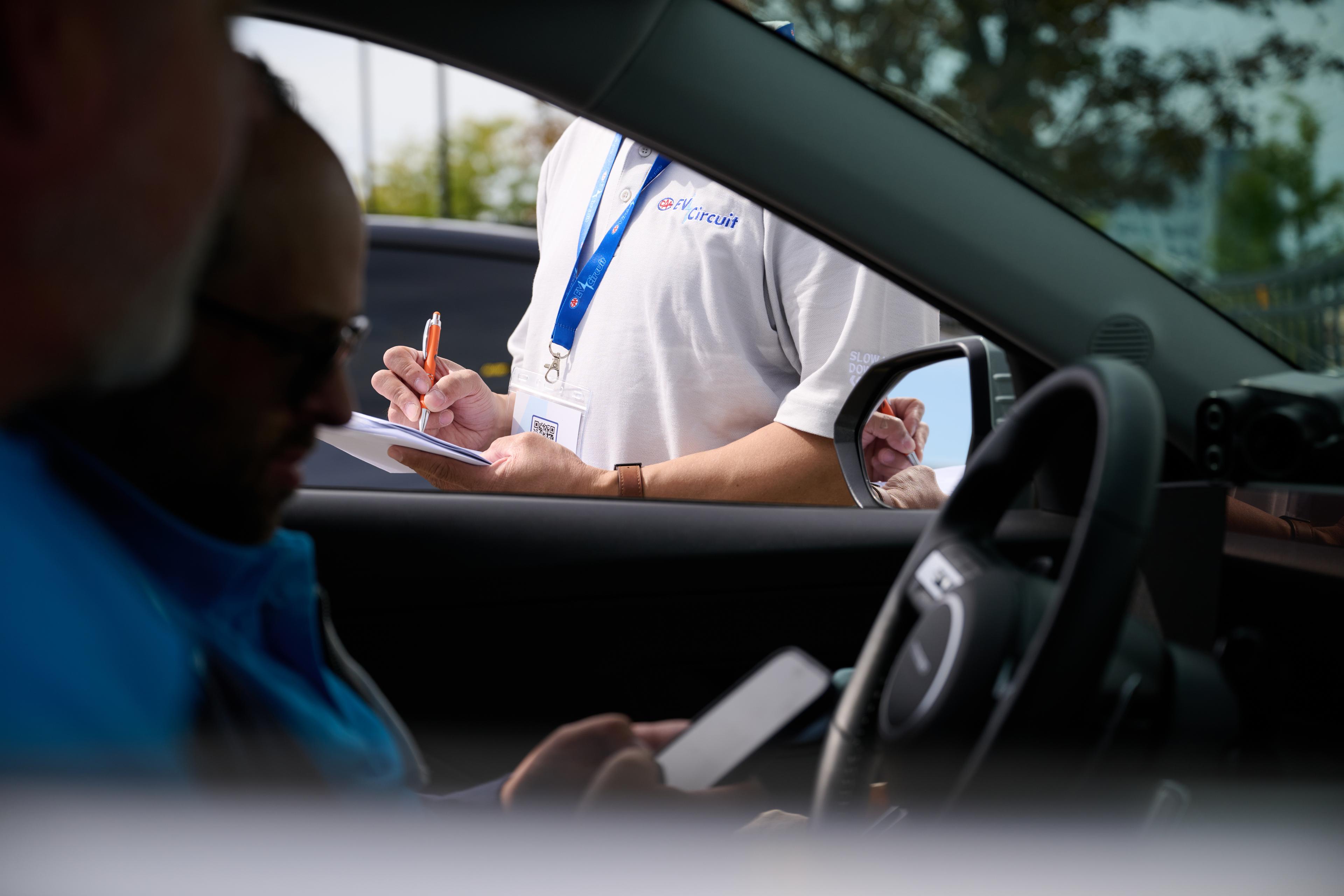
As a green flag waved to kick off the inaugural CAA EV Circuit, 22 drivers in 22 state-of-the-art electric vehicles set off from the Blue Mountain Resort in Ontario for a 230-kilometre journey to gain valuable insight into the modern EV driving experience.
The idea, as laid out by Ryan Peterson, CAA’s manager of automotive services, wasn’t so much a scientific test as it was a case study of real-world EV efficiency, charging speed and driving costs.
What we discovered is that EVs have evolved. Driving range has improved dramatically over the last five years. Among the 22 vehicles on the journey, officially rated driving range varies from approximately 370 km in the gigantic 2025 Volkswagen ID. Buzz minivan to over 820 km in the sleek Lucid Air sedan. Most models offered between 400 and 600 km on a single charge.
“The question is becoming less about whether you can complete a trip and more about how efficiently you can make it, where you will charge, how long charging will take, and what it will cost,” said Kaitlynn Furse, director of corporate communications for CAA South Central Ontario.
As for the results of the first ever EV Circuit, well, they were encouraging, occasionally surprising, and a reminder that no two EVs (or charging sessions) are created equal.
The Route
Our 230 km route looped around rural two-lane highways, winding country roads and through little towns before hitting the suburban outskirts of Toronto. Every vehicle could’ve completed the route without charging, but they all made a pit stop at a public fast-charging station before heading back up Highway 400 to Blue Mountain.
The Cars
As we pulled out of the Blue Mountain parking lot, our 2026 Mercedes-Benz CLA 350 4MATIC Electric — the car I’d been assigned for the Circuit — was showing a full battery with an estimated range of a whopping 609 km. The CLA is the least-expensive EV in Mercedes’ lineup, but it’s not cheap at $62,000.
In terms of price and bodystyle, the 22 models that took part in the Circuit represent a cross-section of the ever-expanding EV market.
There were mainstream compact machines like the Kia EV4 and Nissan Leaf, which — after the $5,000 federal EV incentive — are in the low- to mid-$30,000 range. There were family-friendly SUVs such as the Tesla Model Y, Chevrolet Equinox EV and Volkswagen ID.4, which all start in the $40,000 range. There were bigger SUVs and pickups too, including the Chevrolet Silverado EV and Hyundai Ioniq 9, which are priced in the $60,000 range. And there are luxury models like the Cadillac LYRIQ, BMW iX3, Lucid Air and giant Hummer EV, whose prices start at around $75,000 and run into six-figure territory.
Steven Matos, who works for CAA-supplier Club Assist, was driving the Cadillac Lyriq.
“I’m a lot more confident in the technology and where manufacturers are going with EVs these days. Less range anxiety, good quality, and a lot more options,” he said.
During the lunch stop at CAA Club Group headquarters in Thornhill, he said he used to think EVs were a fad. Now, however, he thinks in a few years buying an EV could be a no-brainer.
The EV Driving Experience
On the road, the Mercedes CLA was quiet, responsive and effortlessly quick, whether taking off from a stop or overtaking on the highway. It also felt roomy for its size, because there’s no bulky combustion engine powertrain taking up space. Not so nice, however, was CLA’s confusing triple-screen infotainment system.
In 2026, that’s all par for the course; modern EVs are nice to drive, but their high-tech cabins can take some getting used to. (Of course, many gas-burning cars use the very same infotainment systems as their electric counterparts.)
For my co-driver Teresa Di Felice, assistant vice-president of government and community relations at CAA Club Group, the Mercedes CLA’s one-pedal driving feature took some getting used to. It lets drivers use the accelerator pedal for speeding up and slowing down; I’ve learned to love it, but it is pretty herky-jerky the first time you try it.
“Since I was last in an EV, technology has moved forward leaps and bounds, and it was a lot of fun,” Di Felice said. “Events like this are meant as a showcase. Don’t be afraid of EV technology. Go out and experience it.”
The EV Charging Experience
Pulling into a Tesla Supercharger station in a supermarket parking lot, we faced a row of 16 fast chargers. That’s right, Tesla chargers aren’t just for Teslas anymore; the network is open to other EVs.
Because of that, however, parking was a challenge. Many of Tesla’s chargers aren’t designed for non-Teslas, so some cars had to park across two spaces or dangerously close to the barriers.
“Sure, we had to park some in weird angles, and sometimes we had to wait a minute or two to pull one in — which is pretty darn good, considering we're charging 22 vehicles basically at the same time,” said Kurt Sampson, EV expert at CAA Atlantic.
CAA hadn’t reserved the charging spots, but it probably helped that we arrived on a weekday afternoon.
Every co-driver had downloaded the Tesla app and made an account to pay for charging. A few taps on the app was all it took to get going. After many struggles with non-Tesla charging stations in all manner of other EVs, I was pleasantly surprised by how smooth charging was.
The Results
Every EV had its strengths and weaknesses. One of the things that stood out across the board, however, was efficiency. On average, the 22 EVs used the energy equivalent of approximately two litres of gasoline per 100 km (Le/100 km).
The most efficient vehicles — Toyota bZ, Tesla Model Y, Model 3 and Kia EV4 — all used less than 1.3 Le/100 km. The least efficient — Lucid Gravity, Hummer EV and Tesla Cybertruck — all used between 2.6 and 3.2 Le/100 km. Vehicle size and weight were the big factors there, but individual driving style played a role as well. (By comparison, the average passenger vehicle consumes roughly eight to 10 litres of gasoline per 100 km.)
As for charging, the Lucid Gravity emerged as the champ, gaining 178 km of (estimated) range in 15 minutes. The Hyundai Ioniq 5, Mercedes and Cadillac all came close with more than 130 km gained.
The Lucid Air gained the least range at just 58 km in 15 minutes, which was strangely low, suggesting its battery was still relatively full to begin with. The Chevy Equinox and Silverado gained 71 and 80 km, respectively.
Charging costs were calculated based on the price of adding 100 km of range. The Teslas were cheapest (less than $9/100 km) but that’s because they get preferential rates at Tesla chargers. The Hyundai Ioniq 5, Kia EV4 and Nissan Leaf weren’t far behind though at $10/100 km. The most expensive was, unsurprisingly, the huge and heavy Hummer EV at $24/100 km. The Chevy Silverado and Rivian R1T came next, at $19 and $18 respectively.
As Sampson explained, public fast chargers are the most expensive way to fill a battery; it’s an option most EV owners use rarely. (Home charging overnight is the cheapest, and most common, charging option.) To complicate matters, prices fluctuated in real time as our group of EVs arrived and departed, hitting $0.70/kWh at one point.
Again, this wasn’t a scientific test. There were so many variables at play. Instead, take the results in sum, as a snapshot of the state of EVs in 2026.
The EV Circuit — and last year’s CAA EV Winter Test — are all part of CAA’s ongoing effort to inform drivers, explained Anita Mueller, senior vice-president of Club & Automotive at CAA Club Group.
“Our goal is not to influence anyone into what type of vehicle to buy,” Mueller said. “Our goal is just to get information and allow people to make an informed decision.”
We’ll analyze the results — comparing fast charging costs to gasoline costs — in a follow-up article, so stay tuned.
Share this article:
Filter by